Case study
Evidence-First RAG
At a glance
- Who it is for
- Engineers who answer questions about message, signal and mapping definitions by opening structured definition files and cross-checking them by hand.
- The problem
- The same message name can appear in two versions of the definition data with different values: in the synthetic data,
SAMPLE_MSG_ENGINE_STATUShas a 10 ms cycle time in one version and 20 ms in another. A search that matches the name can return a correct value from the wrong version, and nothing in the answer shows it. A version here is one snapshot of the definition data. Each snapshot belongs to one project, revision and network. Those four, project, revision, network and snapshot, are the scope that, with the name, identifies an entry. - The design
- A language model only helps find which entity the person means. The person makes the choice. Facts come from registered SQL queries over PostgreSQL, and the page shows them apart from the model's words.
- What was built and checked
- A read-only query runtime, entity search, HTTP and MCP interfaces, a chat relay, and a deployment to Azure. Evaluations were judged against pass marks registered before each run, and every deploy compares the deployed database with a local build.
- Decisions I made
- Most of the code and documents were written by AI coding sessions (Claude Code) and checked by a separate AI review loop. Every decision the workflow reserves for a person was mine: accepting each contract and architecture decision, setting the pass marks, accepting milestones, and merging. Each is recorded on the repository's issues and pull requests.
- Scope and limits
- A personal project on synthetic data. It does not show a comparison with vector search, accuracy on questions it was not tested on, or production operation.
The demo's screen
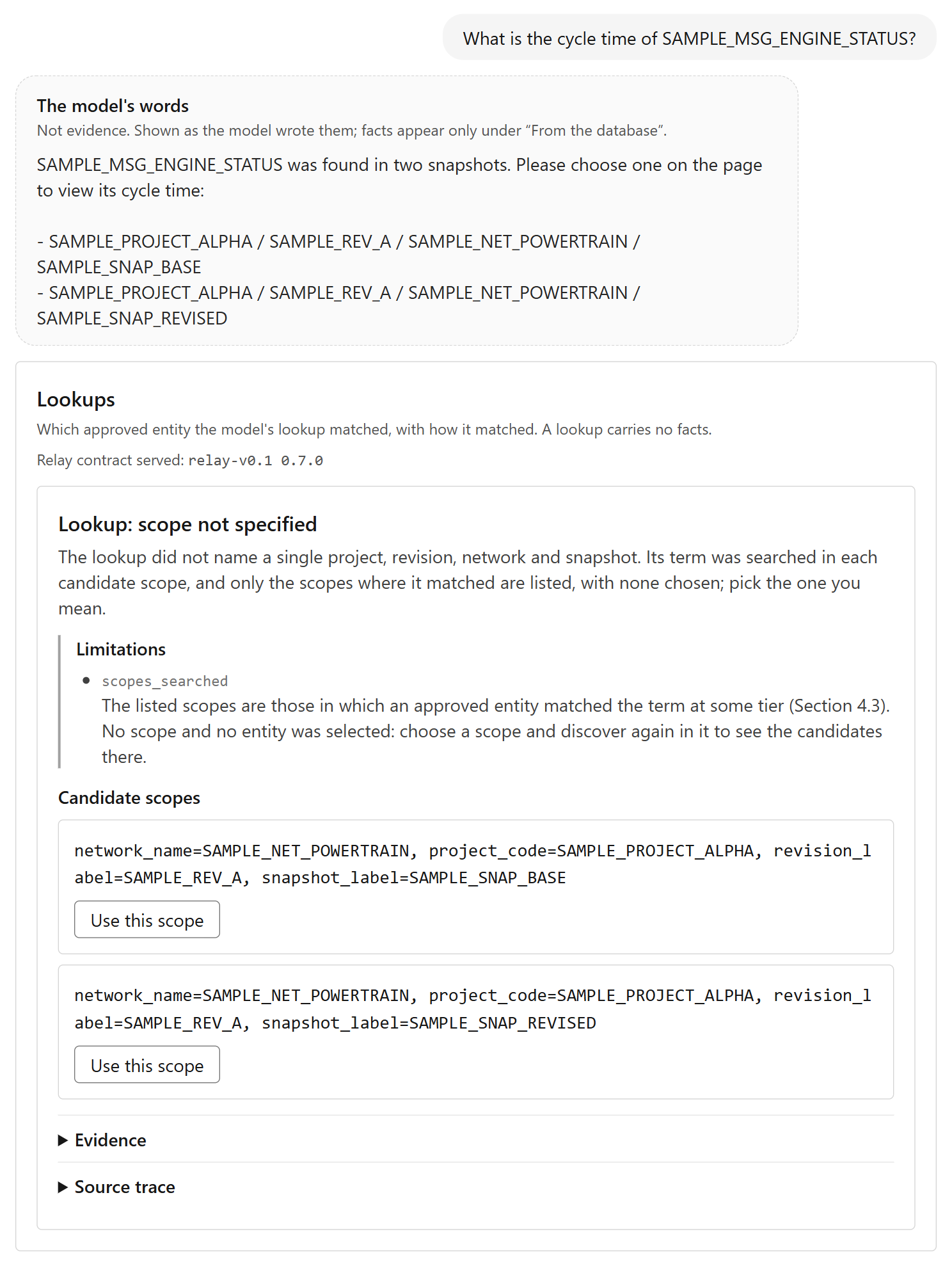
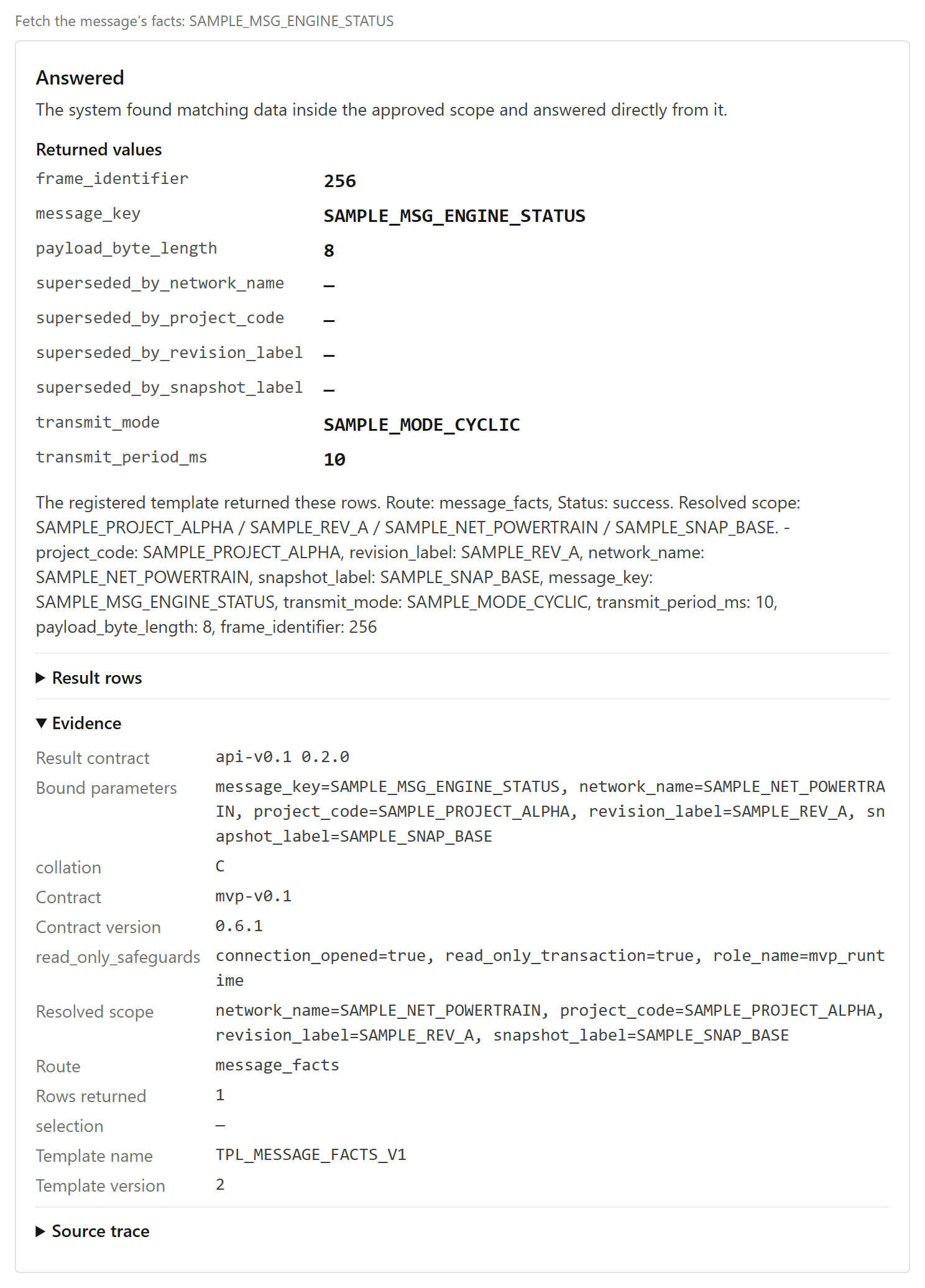
Under “From the database”
1. The problem
An engineer checking a signal or message definition often opens several structured files and compares them by hand. The work is slow to repeat, and another engineer cannot easily check the conclusion later.
This project is a bounded tool for that task. It answers scoped questions about messages, signals and mappings, shows where each fact came from, and says plainly when it cannot answer.
The problem comes from my work in automotive software. Everything in the project, including the data, was written new for it.
2. The failures this design avoids
Three failures shaped the design. For each, this section gives the design decision, how it is checked, and the trade-offs.
Mixing up same-named entries from different versions.
In the synthetic data, SAMPLE_MSG_ENGINE_STATUS has a 10 ms cycle time in one version and 20 ms in another.
- Design decision
- The scope (project, revision, network and snapshot) is part of an entry's identity. The system never fills in a "latest" or default value for any of them. If the scope is unclear, it asks which one is meant instead of answering.
- How it is checked
- The synthetic data deliberately contains same-named entries. Registered test and evaluation cases cover a missing scope and name collisions.
- Trade-offs
- The person has to choose a version more often, and requests carry more parameters.
Treating the model's words as facts.
- Design decision
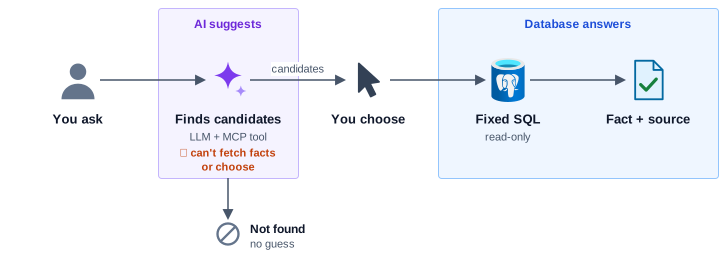
- The model holds one tool, which searches for candidates. It has no tool to fetch facts or to make a choice. A fact appears only after the person clicks, comes from a database route, and is shown in its own region.
- How it is checked
- The relay contract fixes the toolset. A check on every deploy confirms the model's search call.
- Trade-offs
- One extra click. The model's own sentences are not checked and can still be wrong about anything that is not a fact. Other MCP clients see all three tools, and the risks recorded for them remain.
Behaving differently on Azure than locally.
- Design decision
- One container image and one provisioning module, used by CI, the local stack and the deploy. Every deploy rebuilds the database from the commit being deployed.
- How it is checked
- Each deploy compares table row counts, the registry digest and the query-template digests with a local build, and compares the test verdicts. Failed checks roll back both the database and the image.
- Trade-offs
- The database keeps no state, which works only because the data is synthetic. The demo can be unavailable for a few minutes during a deploy.
Records: Synthetic data with same-named entries · ADR-0002 (scoped identity) · ADR-0005 (the chat relay) · Relay contract · Deployment contract
3. The product boundary
It answers scoped questions about messages, signals and mappings, and only through a fixed set of registered, read-only queries over PostgreSQL. It is not a chatbot and has no free-form SQL.
When it cannot answer, it says why, with one of these results:
not_found- : the data covers the question but has no match
coverage_gap- : the data does not cover the question
ambiguous- : more than one candidate or scope
unsupported- : outside what it is built for
invalid_request- : the request's scope or arguments are malformed or contradictory
Records: Project charter
4. How the design changed
The first page was a form. A model could turn a sentence into a draft request, but before any search the form still asked for the kind of entry, message or signal, and its scope. A person uses this tool to find out what the definition data holds, and the form asked them to know it first. When I tried it myself, I searched for "temperature" as a message and got not_found. The term is a signal, and nothing on the page could say so.
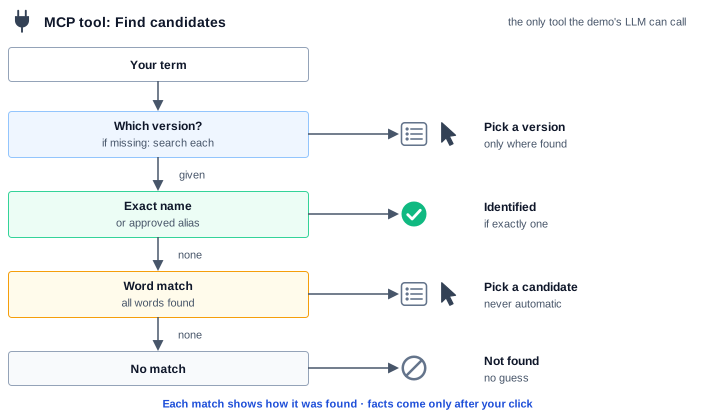
So I moved the work of building the search from the person to a model. The existing search and fact routes became MCP tools: a person describes what they are looking for in their own words, a model turns that into a search, and the candidates come from the database. That also moved where the guarantees end. A tool's result now goes to a model, and what that model writes afterwards is outside what the tools can control.
MCP tools need the reader's own AI client, and there the model holds every tool, so it can choose for the person or fetch facts itself. For the demo, I therefore run the chat myself, through a relay that gives the model the search tool only. The person chooses, and a fact appears only after the person's click.
What stayed fixed throughout is where facts come from: registered, read-only SQL queries over PostgreSQL.
Records: ADR-0004 (MCP surface) · ADR-0005 (the chat relay) · Relay contract · Query runtime (acceptance record)
5. Architecture
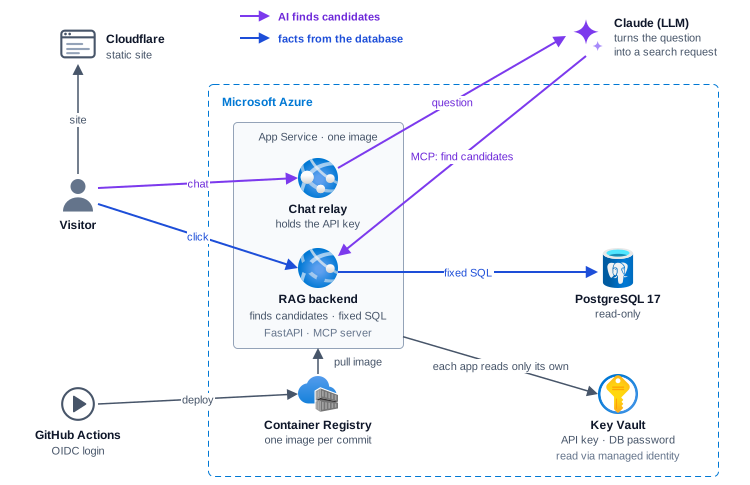
Two paths are kept apart. The search path turns a person's words into candidates; the fact path turns a person's click into a fact. Only the fact path writes to the region labelled "From the database".
Records: ADR-0005 (the chat relay) · Relay contract · MCP contract · HTTP API contract
6. Behavior and evaluation
Every result, negative ones included, carries its evidence: the scope used, the query template and version, the bound parameters, the row count, the source trace and the limitations. Registered test cases compare each result with expected results built separately from the data.
Two evaluations — the model adapter against a deterministic baseline, and entity search on labelled cases — were judged against pass marks registered before the runs.
Their records state the limits plainly: the adapter was tuned on the same cases it was judged on, and the search cases were written from the same rules the search implements, so neither says anything about new questions. The adapter from the first evaluation is not on the demo's path.
Records: Model adapter evaluation (acceptance record) · Entity search evaluation (acceptance record)
7. Deployment
- This site is a static Astro site on Cloudflare Pages. It holds no secret and calls the relay and the database routes from the browser.
- Two apps on one Azure App Service (Linux) plan, both running the same image:
surfaceserves the HTTP and MCP interfaces;relayhandles chat. - Azure Database for PostgreSQL Flexible Server 17.
surfaceconnects with a read-only role;relayhas no database credential. - Secrets in Key Vault, read through each app's managed identity. Only
relaycan read the model provider's key; onlysurfacecan read the database password. - One Docker image, stored in Azure Container Registry under a tag equal to its commit.
- Deploys run from GitHub Actions with OIDC (no stored cloud secret), are started by hand, and come from
mainonly. A failed check rolls back the database and the image.
Records: Deploy records
8. Trade-offs and limitations
Data and evaluation
- All data is synthetic and small: four versions (snapshots), seven messages, thirteen signals, three mappings. Behavior at this size says nothing about a real network database.
- No comparison with vector search was run, and no evaluation on unseen questions exists.
The model and search
- The model's sentences are not checked. Whether it calls the search tool is not in this project's control; the deployed check has seen the call on every run since the relevant change, which is evidence, not a guarantee.
- Matching is by words, not meaning: a synonym is found only if it is registered as an approved alias, and otherwise the search reports no match.
Operation
- Not yet observed on the deployed demo: the daily limits and the model-unavailable state.
- No authentication and no availability commitment: one instance per app, one region, the platform's built-in metrics only.
- Dependencies are version ranges, not locked versions.
Records: Limitations
9. Key decisions and how it was built
Two decisions in this project
The same name in a different scope is a different entry (ADR-0002)
- What I chose
- The same name in a different scope is a different entry. Project, revision, network and snapshot are part of its identity, and the system never fills in a missing scope; it asks which one is meant.
- What I rejected
- Answering by name alone, or filling in the latest or only loaded version.
- Why
An answer about the wrong signal is easy to catch. The dangerous one is a true fact from the wrong scope: a value from one revision when the person meant another. Both are real requirements, and software built on the older one may still build and pass its own tests, so nobody notices. The concern comes from my work with engineering data.
- How it is checked
- The synthetic data deliberately holds same-named entries with different values. Registered evaluation cases with a missing scope or a name collision check that the system asks back instead of guessing, and a data check confirms that same-named entries stay separate in the loaded database.
The model searches; the person chooses (ADR-0005)
- What I chose
- In the demo, the model can only search for candidates. It cannot choose one or fetch facts. The person chooses, and the fact is the database's response, shown apart from the model's words.
- What I rejected
- Letting the model pick a candidate or a scope from the context of the question, and giving it the fact tool as well.
- Why
When a question does not say which revision is meant, guessing it from context is the risk: the answer is a real fact, but maybe not the one the person meant. The system assumes that a person confirms anything ambiguous, and it asks again while it stays ambiguous.
Engineers use a tool like this for a specific investigation, not for a general answer. If they cannot trust each fact, they go back to the source documents. I did not want adding a model to cost that trust.
An MCP server can be connected to any model, and how those models behave is untested. On the path I operate, I did not rely on the model behaving well: the toolset and the relay's check make the system ask back when something is ambiguous.
- How it is checked
- A registered test checks that the call the relay sends to the model enables only the search tool, and that a scope the model takes from an earlier ambiguous result is marked as not the person's. On every deploy, a check sends a registered message to the production relay and confirms that the model called the search tool. Neither check reads the model's sentences.
Records: ADR-0002 (scoped identity) · ADR-0005 (the chat relay) · Relay contract
Not shown yet
This project does not show model training, operating a service with real users, a comparison between retrieval methods, or results on unseen questions.
How it was built
Most of the code and documents were written by AI coding sessions (Claude Code) and checked by a separate AI review loop. Every decision the workflow reserves for a person was mine: accepting each contract and architecture decision, setting the pass marks, accepting milestones, and merging. Each is recorded on the repository's issues and pull requests.